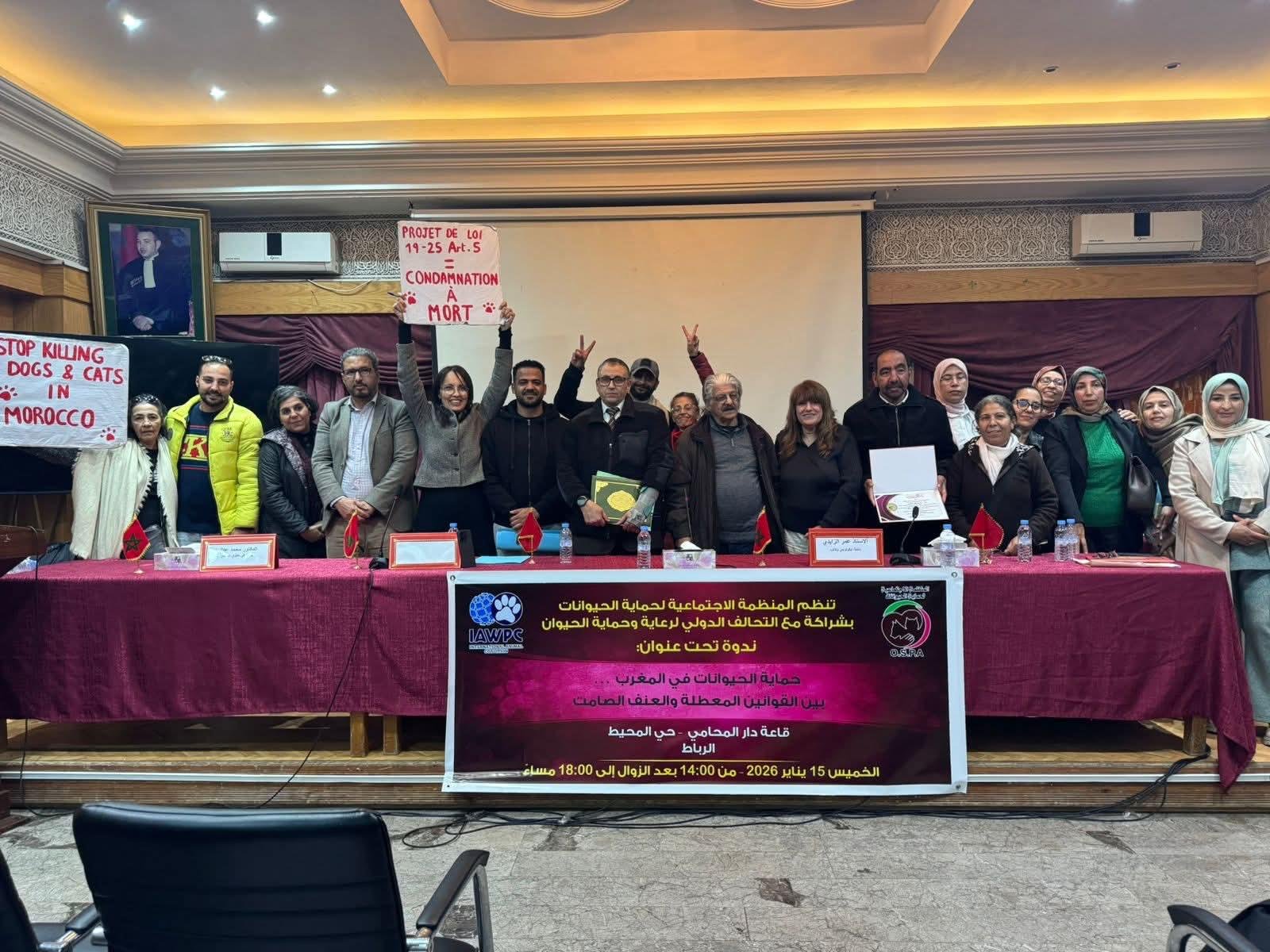
A major press conference in Rabat on Thursday (January 15) has delivered a stark warning to Moroccan authorities, declaring that the continued killing of dogs and cats is not only cruel but a profound failure of governance with serious consequences for public health, environmental balance and human rights.
The conference, organised by the Social Organization for the Protection of Animals and supported by international partners the International Animal Welfare Protection Coalition (IAWPC), drew a strong turnout of national journalists, civil society leaders, researchers, health professionals and human rights advocates. Its message was unambiguous, Morocco’s reliance on violent eradication methods is scientifically discredited, socially damaging and legally indefensible.
Opening the event, the organisation’s president, legal advisor and political science researcher Meryem Sabahi, delivered a sweeping and uncompromising diagnosis of the crisis.
She said: “This is not a marginal debate, nor a discussion about street nuisance. It is, at the same time, a political, legal, health, and educational issue. Animals have not “taken over” the streets; they have been pushed there by structural failures in urban planning, the absence of preventive public policies, the failure of environmental health management, and the accumulation of years of easy but violent solutions. The real problem is not the presence of animals, but the absence of a clear state vision and coherent governance by public and local authorities.”
She continued by warning that the killing of dogs and cats actively undermines the very public safety arguments used to justify it: “When we speak about animal protection, we are in fact addressing core issues of public health, citizen safety, environmental balance, and community security. Scientific studies and comparative international experiences have demonstrated beyond any doubt that the violent eradication of dogs and cats leads to the proliferation of rodents, the spread of diseases more dangerous than those it claims to prevent, increased public health costs, and a complete failure to resolve the phenomenon. Despite this evidence, some local authorities continue to rely on killing in public spaces, near water sources, in residential neighborhoods, and in front of vulnerable populations.”
A representative from the Ministry of Health confirmed that Morocco officially recognises CNVR, catch, neuter, vaccination and release, as the humane and scientifically proven approach to managing free-roaming dog and cat populations. However, he acknowledged serious barriers to implementation, including weak coordination, insufficient resources and the continued use of outdated and harmful killing methods by some local authorities.
Further interventions underscored the wider damage being caused. Researcher and technology author Omar Zaidi warned that mass killing creates an ecological vacuum, increasing rodent populations and disease risk. Child rights specialist Dr Mohamed Allali described the exposure of children to public animal killings as psychological violence, linking it to trauma, desensitisation and an increased risk of violent behaviour later in life.
In a detailed legal presentation, Meryem Sabahi highlighted major shortcomings in Draft Law 19.25, the binding nature of Morocco’s 2019 international commitments, and a landmark judicial ruling against the Ministry of the Interior that established state accountability. She announced that proposed amendments to the law have now been submitted to Parliament’s Legislation and Laws Committee, with formal correspondence also sent to the Royal Cabinet.
Notably absent from the conference were representatives of the Ministry of the Interior and the National Office for Food Safety, despite confirmed invitations, an omission organisers noted.
Les Ward MBE, chairman of the IAWPC, which helped facilitate the conference, said the event marked a critical moment of truth for Morocco, he said: “What we heard in Rabat was a clear, evidence-based indictment of mass dog and cat killings. This is not activism versus authority, it is science, law and public health versus outdated violence. Morocco has the tools, the knowledge and international support to implement humane solutions. What is now required is political will and accountability to end practices that harm animals, traumatise communities and ultimately endanger human lives.”
The conference concluded with formal recommendations to be submitted to the relevant authorities and a commitment to sustained institutional follow-up.